
Which Auto Rickshaw Is More Profitable in India
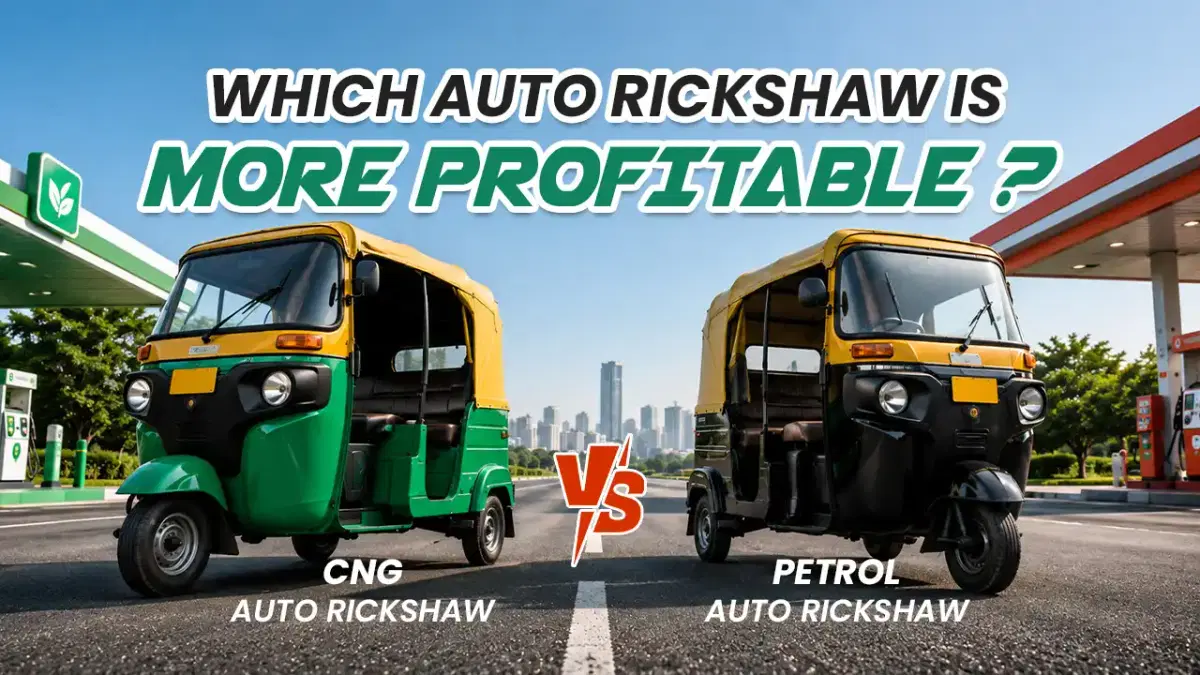
CNG vs petrol auto rickshaw is the first calculation every new driver runs before signing a loan paper, and in June 2026 the honest answer is that CNG wins on running cost for anyone clocking serious daily kilometres, while petrol still holds ground for low-mileage and CNG-starved towns. Auto rickshaws in India are priced anywhere between ₹2.20 lakh and ₹3.30 lakh ex-showroom depending on fuel type and variant, and that upfront gap matters just as much as the per-kilometre math once EMIs enter the picture.
For a driver doing the usual passenger-auto grind in Delhi, Mumbai, Pune, or any tier-1 city, profitability boils down to one number: rupees spent per kilometre versus fare collected per kilometre. Auto rickshaw mileage is the starting point for that math. A CNG auto rickshaw running at 28-35 km/kg against gas priced around ₹75-₹90/kg works out to roughly ₹2.20-₹3.20 per kilometre. A petrol auto rickshaw managing 25-30 km/litre against fuel at around ₹103/litre lands closer to ₹3.40-₹4.10 per kilometre. That difference sounds small until you multiply it across a full working month, and that is exactly where CNG auto rickshaw running cost pulls ahead for high-mileage operators.
Monthly Running Cost for 100 km a Day
Take a driver covering 100 km per day, which is fairly standard for a city passenger auto working full shifts. On CNG, daily fuel spend lands around ₹220-₹320, pushing the monthly fuel bill to roughly ₹6,600-₹9,600. On petrol, the same 100 km/day translates to daily fuel cost of about ₹340-₹410, or ₹10,200-₹12,300 a month.
Over a year, that gap alone can cross ₹30,000-₹40,000, money that goes straight into a driver's pocket or toward clearing the auto rickshaw EMI faster. This is the single biggest reason fleet owners and full-time drivers lean CNG whenever the city's gas network supports it.
Purchase Price and EMI Pressure
Here the equation flips a little. A petrol auto rickshaw typically costs approximately ₹2.20 lakh-₹2.80 lakh ex-showroom, while a CNG variant of the same body sits higher at approximately ₹2.60 lakh-₹3.30 lakh ex-showroom because of the cylinder, regulator, and dedicated fuel-line hardware.
On-road price in Delhi, Mumbai and other major cities will be higher after RTO, insurance, permit and other charges, often adding ₹25,000-₹40,000 over the ex-showroom figure depending on the state and whether it is registered as a commercial three-wheeler in India. That higher upfront cost means a CNG auto rickshaw EMI is usually a few hundred rupees more per month than a comparable petrol loan, but the fuel savings from month one typically cover that extra instalment and then some, provided the driver is actually putting in 80-100 km of daily running.
Maintenance and Resale Value
Petrol auto rickshaw maintenance cost tends to be lower per service visit since the mechanical layout is simpler and parts are available at almost any roadside garage across India. CNG variants need periodic cylinder testing and occasional attention to the gas kit and regulator, which means slightly higher annual maintenance outgo and a dependency on authorised service points.
On resale, CNG autos once fetched a discount in the second-hand market, but that gap has narrowed as CNG infrastructure has expanded and buyers increasingly prefer lower running cost over the marginally higher maintenance bill. Real-world choices in this segment include the Bajaj Compact RE, TVS King, Piaggio Ape, and Mahindra Alfa, with CNG and petrol versions available across most of these badges depending on city and dealer stock.
City-Use Practicality and CNG Availability
This is where the comparison gets genuinely complicated, because CNG vs petrol auto rickshaw is not just a fuel-cost question, it is a fuel-access question. In Delhi-NCR, Mumbai, and most of Gujarat, CNG stations are dense enough that refuelling rarely eats into a driver's working hours.
But in many tier-2 and tier-3 towns, CNG stations are still thin on the ground, and drivers can lose 20-40 minutes standing in a queue during peak hours, time that translates directly into lost fares. A driver in a city with limited CNG infrastructure is often better served by a petrol auto rickshaw despite the higher running cost, simply because uptime and fare-earning hours matter more than fuel price per kilometre when the queue at the only CNG pump in town stretches for half an hour.
Best Auto Rickshaw for Daily Earning by Driver Type
Daily passenger auto drivers doing 80-150 km a day in a city with solid CNG coverage should default to CNG without hesitation, since the fuel savings compound fast enough to offset the higher purchase price within the first year or so. Short-distance city operators running food delivery, courier, or small-goods routes under 50-60 km a day may find the petrol option more practical, since lower daily running reduces how much the fuel-cost gap actually matters, and the lower ex-showroom price eases the EMI burden.
Low-running private or semi-commercial users, including those who only drive a few hours a day, often do not recover the CNG premium fast enough to justify it and are better off with petrol. Drivers in cities with poor CNG availability, regardless of how many kilometres they run, should also lean petrol, because a vehicle stuck in a refuelling queue earns nothing.
CNG vs Petrol Auto Rickshaw Comparison
| Factor | CNG Auto Rickshaw | Petrol Auto Rickshaw |
|---|---|---|
| Fuel cost per km | ₹2.20-₹3.20 | ₹3.40-₹4.10 |
| Mileage/range | 28-35 km/kg | 25-30 km/litre |
| Purchase price ex-showroom | ₹2.60 lakh-₹3.30 lakh | ₹2.20 lakh-₹2.80 lakh |
| Maintenance | Slightly higher, needs authorised service | Lower, widely serviceable |
| Daily earning suitability | Best for 80+ km/day routes | Best for under 60 km/day routes |
| Best use case | High-running city passenger autos | Low-running, delivery, or low-CNG cities |
The table makes the verdict fairly obvious once you separate purchase cost from running cost. For anyone putting in real daily kilometres in a city with decent CNG coverage, the fuel savings outweigh the higher EMI within months, and CNG comes out as the more profitable choice over the vehicle's working life. Petrol only wins when running is genuinely low, when the route is short and stop-go rather than long-haul, or when the local CNG network simply cannot support reliable daily refuelling.
Verdict: CNG or Petrol for Maximum Profit
Weighing CNG vs petrol auto rickshaw economics over a full year, the numbers point in one clear direction for most full-time drivers. CNG is usually the more profitable choice for high daily running because the per-kilometre fuel saving adds up fast enough to absorb the higher purchase price and EMI within the first year of ownership.
Petrol still makes sense for low daily running, short-haul delivery-style use, or anywhere CNG stations remain scarce and refuelling queues cost more in lost fares than the fuel saves. Before signing on for either option, compare exact models using a list of the Best Auto Rickshaws in India, or the Best Electric Auto Rickshaws in India if going electric appeals, and run the numbers through an Auto Rickshaw Loan and EMI Guide before committing to a down payment.
Check the on-road price and EMI for the auto rickshaw in your city on Drivio.