
Best Commercial Vehicles for City Delivery: 5 Picks From ₹3.99L

The best commercial vehicles for city delivery in India now start at ₹3.99 lakh (ex-showroom) with the Tata Ace Pro, and the spread across petrol, CNG, diesel and electric is wider in November 2026 than it has ever been. For a fleet owner or a first-time operator, the wrong pick costs more than a higher sticker price: a gap of ₹3,000 a month in running cost adds up to ₹1.8 lakh over a 60-month loan. Here is how the main contenders compare on Indian roads.
Best Commercial Vehicles for City Delivery: What Actually Matters
City delivery in India is a stop-start job. You are looking at 80 to 120 km a day, narrow lanes, basement docks with low clearance, and loads of 500 to 900 kg in cartons, parcels and FMCG stock. That changes how you read a spec sheet. Payload decides how many drops you make per trip, GVW decides whether you stay on the right side of an overloading challan, and a short turning circle decides whether you can reach the last lane at all. Running cost matters most, because a mini truck covering about 2,600 km a month spends more on fuel than on its EMI. Many city administrations are also nudging goods fleets towards CNG and electric, so the fuel you choose today can affect where you are allowed to operate tomorrow.
Tata Ace Pro Petrol and Bi-Fuel: The ₹3.99 Lakh Entry Point
The Tata Ace Pro is the cheapest way into a four-wheel mini truck. The petrol version costs ₹3.99 lakh ex-showroom and uses a 694 cc engine making roughly 30 bhp and 55 Nm, with a 750 kg payload and a GVW of about 1,460 kg. On-road price in Delhi will be approximately ₹4.3 lakh, and a 20% down payment with a 60-month loan at 11% works out to an EMI near ₹6,900. The bi-fuel CNG-plus-petrol version costs ₹4.99 lakh, makes about 25 bhp and 51 Nm, and keeps a 5-litre petrol tank as backup for days when CNG stations are crowded. The trade-off is power: expect the petrol motor to feel stronger than the CNG one with a full load on a flyover gradient. Tata designed the Ace Pro for operators moving up from three-wheelers, and the price and payload suit that buyer well.
Tata Ace Gold+ Diesel: The Heavy-Load Choice
When daily loads touch 800 kg, the Ace Gold+ diesel is the sensible step up. It costs ₹5.52 lakh ex-showroom after the GST cut, carries 900 kg, and its 700 cc BS6 engine makes 22 PS and 55 Nm. The DEF-free emission system removes the AdBlue top-ups that other BS6 diesels need, a small saving that adds up across a year. Real-world mileage in city traffic is likely 16 to 19 kmpl, so at 17 kmpl a 2,600 km month needs about 153 litres, or roughly ₹14,500 of diesel at ₹95 a litre. The EMI comes to around ₹9,600, and on-road price in Mumbai will be approximately ₹6 lakh. Against the Ace Pro petrol you pay about ₹1.5 lakh more for 150 kg of extra payload, which only makes sense if you fill that capacity every day. Our Tata Ace EV vs Ace Gold Diesel comparison shows how this diesel holds up against electric.
Mahindra Jeeto Plus CNG vs Maruti Super Carry CNG
CNG is where the price war is fiercest. The Mahindra Jeeto Plus CNG costs about ₹5.26 lakh, with a 625 cc engine making 20 bhp and 44 Nm and a payload of up to 650 kg. The Maruti Super Carry CNG costs about ₹6.11 lakh, uses a 1.2-litre K-Series engine with roughly 65 bhp and 85 Nm, and carries around 625 kg. On paper the Super Carry has more than three times the power. In practice, city loads below 650 kg rarely need it. Mahindra claims 35 km/kg for the Jeeto against about 23 km/kg for the Maruti; even if the Jeeto delivers a real-world 25 km/kg, a 2,600 km month needs roughly 104 kg of CNG, or about ₹8,000 at ₹75 to ₹80 a kg. The Super Carry earns its premium on routes that mix city drops with highway stretches to warehouses on the outskirts. For pure inner-city work, the Jeeto Plus CNG is the winner of this pair.
Tata Ace Pro EV: Cheapest to Run, With a Catch
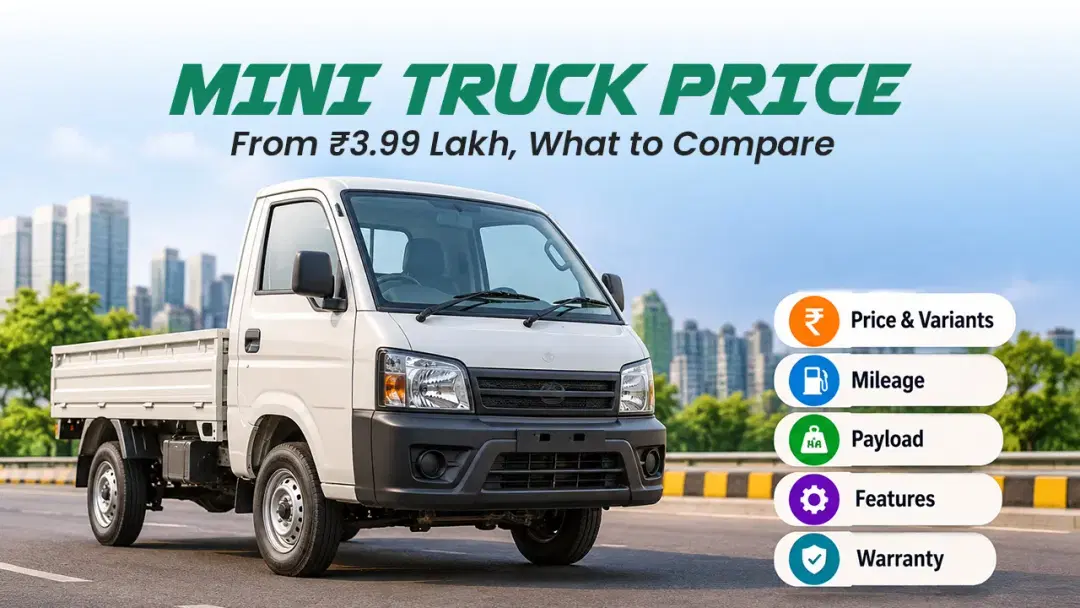
The Ace Pro EV starts around ₹6.50 lakh ex-showroom and pairs a 14.4 kWh LFP battery with a 29 kW (about 38 bhp) motor and 104 Nm of torque, the strongest pull from a standstill in this group, which matters at every junction. Tata certifies 155 km on a charge. With a full load the real-world figure is likely 110 to 120 km, still enough for a 100 km day. Electricity at roughly ₹8 a unit puts monthly energy cost near ₹2,500 to ₹3,000, against about ₹14,500 for the diesel. That saving of over ₹11,000 a month recovers the roughly ₹1 lakh price premium over the Ace Gold+ in under a year, before any state subsidy. The catch is charging access: without a fixed overnight charging point, the numbers weaken fast. For a wider view of what each segment costs, see our guide to mini truck price in India.
Verdict: Which One Should You Buy
Pick by duty cycle, not by price tag. Operators carrying under 700 kg who want the lowest entry cost should take the Ace Pro petrol, and those near 900 kg should take the Ace Gold+ diesel. CNG-heavy fleets running 100 km a day should favour the Jeeto Plus CNG. For fixed routes with overnight charging, the Ace Pro EV is the strongest of the best commercial vehicles for city delivery on running cost alone, and the payback maths is hard to argue with in November 2026. Whichever you shortlist, check the on-road price and EMI for the Tata Ace Pro in your city on Drivio before you visit a dealer, because Delhi, Mumbai and Bengaluru quotes will not match.







Popular Trucks
Tata Intra v10
₹7.28 Lakh Onwards
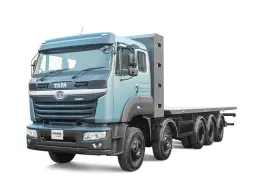
Tata Prima 35.K Auto Shift
Price to be announced
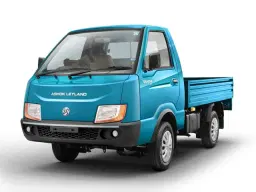
Ashok Leyland Saathi
₹6.50 Lakh Onwards

Mahindra Bolero PIK UP FB 1.3T - PS AC
₹10.48 Lakh Onwards
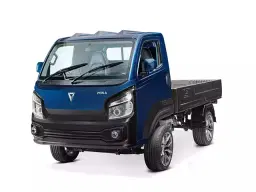
Omega Seiki M1ka
₹15.00 Lakh Onwards
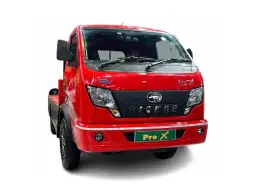
Eicher Pro x
₹17.49 Lakh Onwards
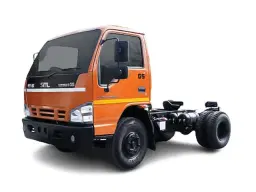
Swaraj Mazda Samrat GS Tipper Chassis
₹21.24 Lakh Onwards
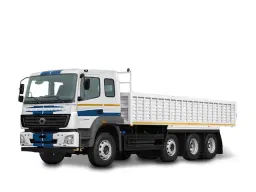
Bharat Benz 3123R
₹40.97 Lakh Onwards
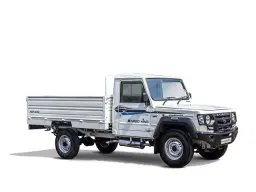
Force Kargo King
₹6.49 Lakh Onwards
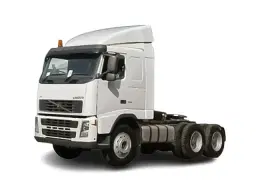
Volvo FM 440 6x4
₹70.00 Lakh Onwards