Monthly Profit From a Pickup Truck: What Indian Operators Actually Take Home
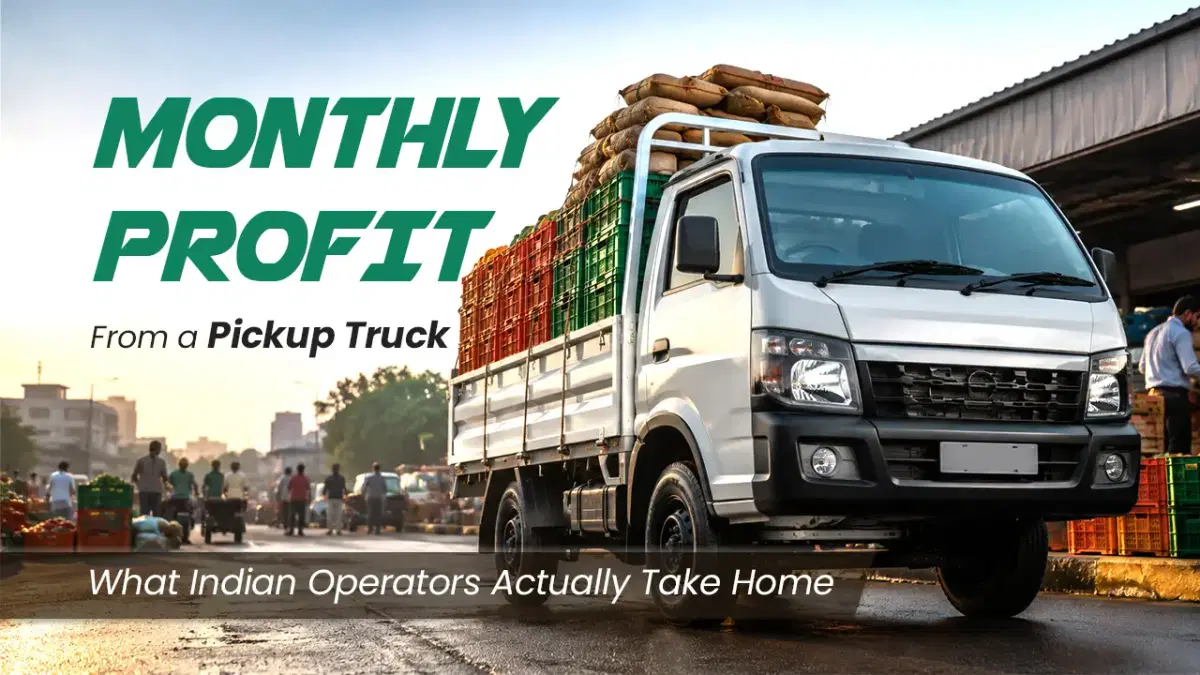
Monthly profit from a pickup truck in India usually settles between ₹12,000 and ₹55,000 every month, and the gap between those two numbers depends almost entirely on who drives the truck and what route it runs. Pickup trucks in India are priced anywhere from ₹7 lakh to ₹12 lakh ex-showroom, depending on model and variant, which makes this one of the more accessible entry points into commercial vehicle ownership. The on-road price in Delhi or Mumbai will usually climb higher than the ex-showroom figure once registration, insurance, road tax and permit costs are added, so the real test isn't the brochure mileage figure dealers like to quote — it's whether the truck still leaves money behind after diesel, EMI and maintenance are paid every month.
Pickup Truck Income in India Depends on the Load, Not the Brand
Pickup truck income in India changes sharply based on what the truck is hired to carry and how many return trips it manages in a day. A truck running fruits and vegetable transport from a mandi to local markets tends to get one solid loaded trip early morning and a lighter return load, while e-commerce delivery work spreads smaller parcels across more stops and more idle time in traffic. Construction material haulage — sand, bricks, cement bags — usually pays better per trip but comes with rougher loading and faster tyre wear, which eats into pickup truck running cost over the year. Intercity small-load trips can pay well per kilometre but expose the operator to empty return legs, which is the single biggest reason monthly income swings between a good month and a tight one.
Pickup truck earning per day in cities like Delhi NCR, Pune or Ahmedabad typically ranges from ₹2,500 to ₹4,500 depending on the type of work and how consistent the load contacts are. Operators running fixed contracts with local kirana distributors or e-commerce hubs tend to see steadier daily numbers than those depending on open-market loading points, where waiting time for a return load can quietly eat several hours of productive driving every single day.
Calculating Monthly Profit From a Pickup Truck: A Realistic Example
Working out monthly profit from a pickup truck requires lining up running cost, EMI and earning side by side rather than guessing. For a pickup truck doing 100 km a day across 26 working days, monthly running comes to 2,600 km. At a real-world diesel mileage of 12 kmpl and diesel priced around ₹95 per litre, fuel cost works out to approximately ₹20,500–₹21,000 a month. Pickup truck mileage on Indian roads usually sits between 11 and 15 kmpl for diesel models, and 18–24 km/kg for CNG variants, so the actual fuel bill can shift meaningfully depending on load, route and how much time the engine spends idling in traffic.
Owner-Driver Model vs Driver-Operated Model
An owner-driver running this truck himself usually ends up with approximately ₹30,000 to ₹55,000 in monthly profit, because the driver salary line simply disappears from the cost side. A driver-operated truck, where the owner hires someone to run the vehicle daily, brings that final number down to roughly ₹12,000 to ₹30,000, since driver salary in most Indian cities runs ₹18,000 to ₹25,000 a month depending on experience and route difficulty. Owner-drivers also tend to manage fuel and loading more carefully than hired drivers, which quietly improves real-world mileage and trims commercial pickup truck profit erosion that often goes unnoticed on paper. The trade-off is time and physical effort — owner-driving works best for someone who can commit full working days to the truck rather than running it as a side income source.
Pickup Truck vs Mini Truck or Three-Wheeler Cargo: Which Earns More
A three-wheeler cargo vehicle costs far less upfront and sips less fuel, but it caps out quickly on both payload and the kind of work it can take on — long mandi runs or bulk construction material are simply out of reach. A mini truck sits in between, offering more cargo room than a three-wheeler with running costs lower than a pickup, though it usually can't match a pickup truck's mix of payload, road presence and resale value across both rural and urban routes. The Mahindra Supro Profit Truck competes directly in this mini truck space and is worth cross-checking against pickup options before deciding, especially for buyers focused purely on local intracity delivery. For operators who need flexibility — switching between e-commerce delivery one week and construction material the next — a pickup truck like the Tata Yodha 2.0 usually justifies the higher EMI through broader earning options.
Where the Profit Actually Disappears
EMI is the cost line that most first-time buyers underestimate when they calculate monthly profit from a pickup truck, because it doesn't flex with how much work the truck actually gets in a given month. A truck financed aggressively with a ₹25,000+ EMI can turn a decent earning month into a break-even one the moment load availability drops or a tyre needs replacing unexpectedly. Permits, insurance renewals and the return-trip problem — where a truck runs loaded one way and empty the other — also chip away at numbers that look comfortable on a spreadsheet but feel tighter by the 25th of the month. Buyers should treat profit estimates as a range, not a guarantee, since fuel price, route congestion and seasonal demand for goods transport all move month to month.
Pickup truck ownership makes the most sense for buyers who already have regular load contacts, a fixed delivery route, or a standing relationship with a mandi, distributor or construction contractor before the truck is even financed. Buying on the assumption that work will show up after delivery is where EMI pressure turns risky fastest, since the first two or three months without steady loading can set an operator back further than expected. Before signing anything, check the on-road price and EMI for the pickup truck in your city on Drivio Trucks.